


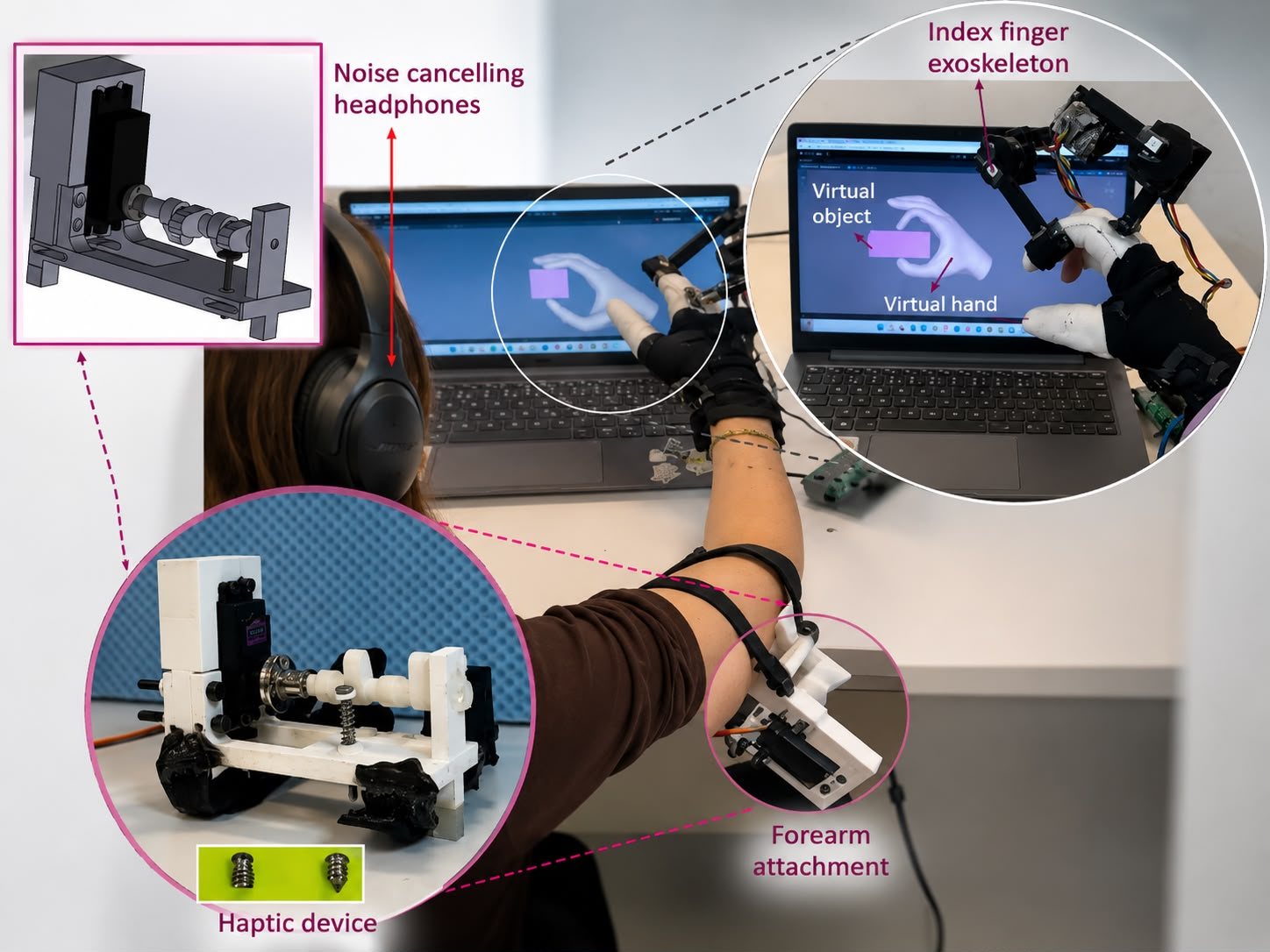
Part of the HANDSENSE project, this work develops and characterises a wearable tactile feedback system for prosthetic hand control.
It investigates Innocuous Painful Feedback (IPF) as a high-saliency sensory cue for detecting and correcting grasp-related errors. The research characterises the effect of the key stimulation parameters, amplitude, frequency, rise time, contact duration and stimulation location, while also accounting for phantom phenomena that can influence sensory perception in amputees.
A wearable tactor is designed and integrated with a prosthetic-like grasping platform to deliver controlled mechanical stimulation to the residual limb, and the system is evaluated through controlled human-subject experiments examining perception, detection and response under different feedback conditions.
The aim is a sensory substitution approach that reduces reliance on visual feedback, allows rapid error detection and correction, and improves grasp accuracy and human–prosthesis interaction.
Video
Project team

Darin Elessavy
Graduate Researcher
Haptic and painful sensory feedback for prosthetic control and human–machine interfaces.
Related publications
Innocuous Painful Feedback for Boundary-Constrained Position Control in Prosthetic-Like Grasping
D. Elessavy & E. Hocaoglu
IEEE International Conference on Cyborg and Bionic Systems (CBS)