
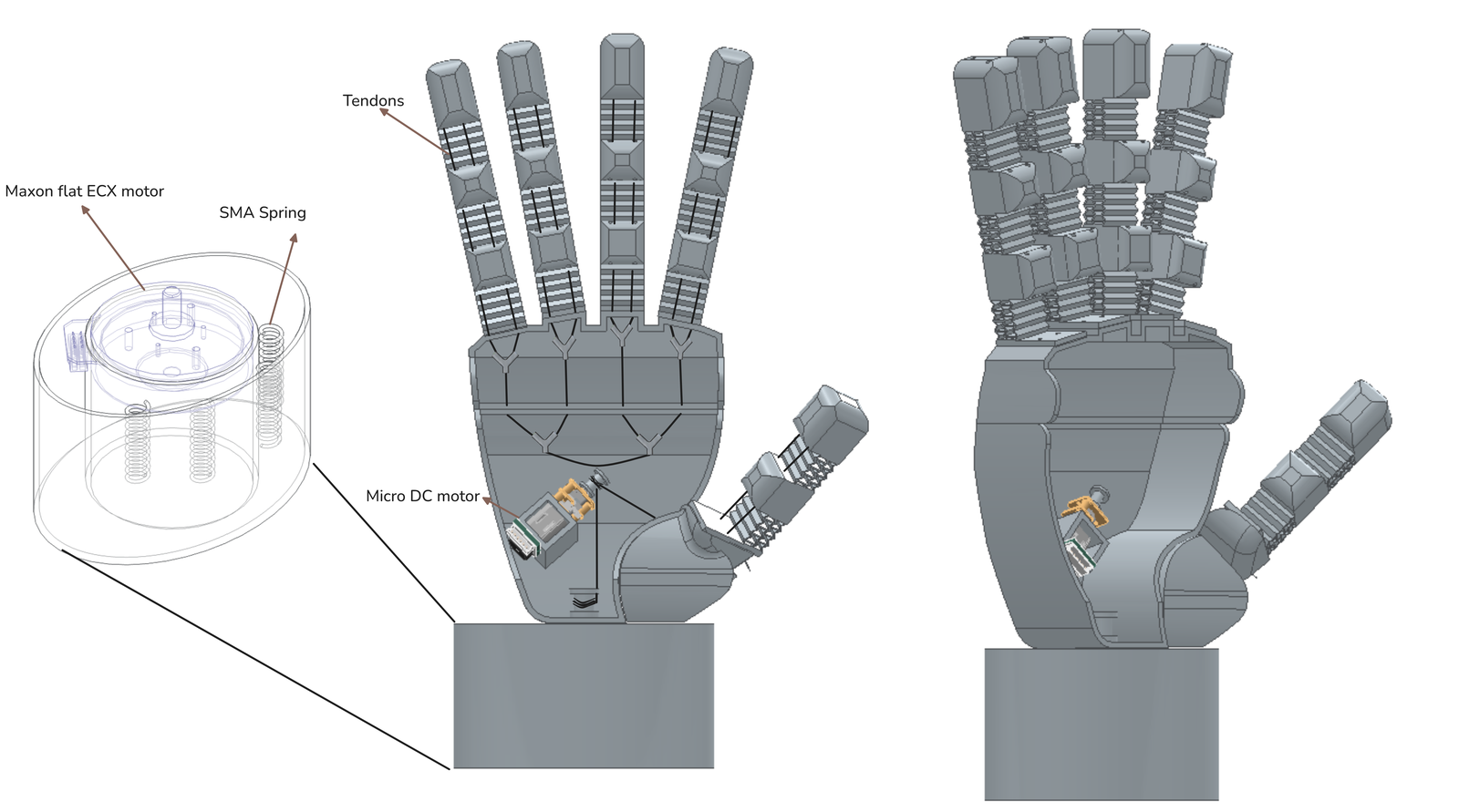
SENSEHand brings together two strands of the laboratory’s prosthetics work: a hand whose compliance is built into its mechanics, and a control interface that reads what the user intends rather than waiting to be told.
An underactuated, variable-stiffness hand
The hand achieves adaptive and safe grasping with a minimal number of actuators. Its finger joints are built from auxetic, negative-Poisson’s-ratio metamaterial flexures whose stiffness is governed by a single geometric parameter, determined through multi-objective optimization balancing actuation force against structural durability. That embeds an anthropomorphic proximal-to-distal closing sequence directly in the mechanical structure, with no per-joint control.
On top of this passive design, shape-memory-alloy springs provide active, discrete stiffness levels, which decouples stiffness modulation from motion generation: the motor governs how far the fingers close, the SMA governs how stiff the grasp is. Control combines a closed-loop motor-position channel with an open-loop, characterization-driven SMA stiffness channel regulated by a Hall-sensor current loop. The work spans kinematic and quasi-static modeling, finite-element analysis, prototype fabrication and experimental validation.
Control that follows the user
The control strand develops a more intuitive and adaptive algorithm for prosthetic hands. Rather than relying on predefined commands, discrete grasp selection or repeated mode switching, it studies how people naturally adapt their hand and finger behaviour when interacting with different objects and conditions, and transfers that into the control law, so that user intention and changing daily conditions are both accounted for. An earlier stage of this work, on sEMG-based one-dimensional fingertip stiffness modeling and classification, was presented at SIU 2026.
Video
Project team
Ahlam Sawah
Graduate Researcher
Variable-stiffness mechanisms and compliant joint design for underactuated prosthetic hands.
Buket Ünal
Graduate Researcher
sEMG-based human–machine interaction, fingertip stiffness estimation and adaptive prosthetic-hand control.